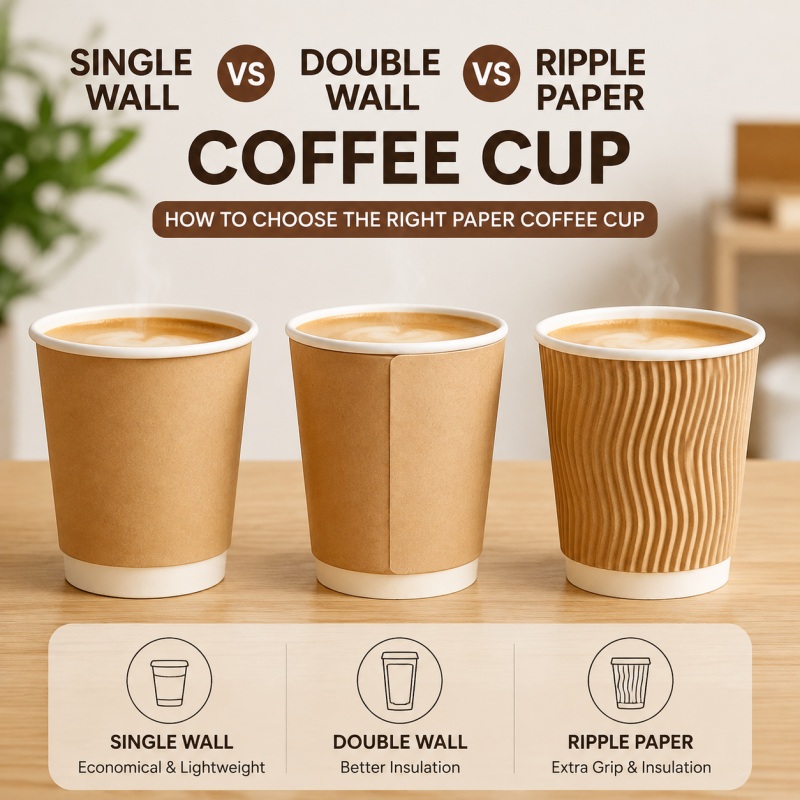
 Vaso de papel para café de pared simple vs. pared doble vs. pared ondulada: cómo elegir el vaso de papel adecuado
Aug 18, 2026
Vaso de papel para café de pared simple vs. pared doble vs. pared ondulada: cómo elegir el vaso de papel adecuado
Aug 18, 2026
Elegir lo mejor vaso de café de papel Esto implica equilibrar los costos del producto con la velocidad de los trabajadores, el espacio de almacenamiento, la resistencia del vaso y la seguridad del cliente. Los vasos de pared simple son más económicos al principio. Los diseños de doble pared mantienen las bebidas calientes para que los clientes se sientan cómodos. Tazas de café con diseño de pared ondulada Ofrecen la mejor protección contra el calor y un agarre firme durante las horas punta. Tipo de copaPrecio FOB de 12 ozAislamiento térmicoSe necesita mangaComodidad de agarreRobustezAplicación principalPared simple$0,020–$0,030BajoSíBásicoEstándarBebidas calientes con hielo o envasadasDoble pared$0,042–$0,062AltoNoLisoAltoEspresso caliente de gran volumenMuro ondulado$0,055–$0,075MáximoNoTexturizadoMáximoEntrega a domicilio premium Conclusiones claveLos vasos de pared simple cuestan menos inicialmente, pero requieren fundas adicionales para las bebidas calientes.Las tazas de doble pared mantienen el café caliente hasta un 30 por ciento más de tiempo sin necesidad de fundas.Los vasos con paredes onduladas proporcionan la máxima protección contra el calor y un agarre seguro y antideslizante.Los vasos multicapa eliminan los pasos de colocación de fundas, lo que permite ahorrar al personal hasta 25 minutos por cada hora punta. Vaso de café de papel de pared simple vs. pared doble vs. papel ondulado Especificaciones y diseño de capas de la copa de pared simpleElija opciones de pared simple para operaciones de bebidas sencillas. Los fabricantes construyen estándar vaso de café de papel de una sola pared Unidades que utilizan cartón kraft blanqueado sin tratar con un gramaje de entre 170 g/m² y 280 g/m². El gramaje total del cartón recubierto de PE oscila entre 190 g/m² y 280 g/m². Una capa interior de plástico evita fugas de líquido. Los vasos para bebidas frías utilizan un revestimiento de 15 a 18 micras. Los vasos para bebidas calientes requieren una capa interior de 20 a 25 micras. Las bebidas calientes a 60 °C o más requieren una base de papel más gruesa de 350 g/m² más una funda de papel adicional para proteger las manos del usuario del calor.Seleccione el tamaño de vaso adecuado según las necesidades de su menú. Un recipiente pequeño de 118 ml (4 oz) es ideal para un espresso individual o muestras de bebidas. Los tamaños estándar de 237 ml (8 oz) y 355 ml (12 oz) son perfectos para capuchinos y lattes calientes. Los tamaños más grandes de 473 ml (16 oz), 591 ml (20 oz) y 710 ml (24 oz) son ideales para bebidas frías o frappés. Ingeniería de doble pared y pared onduladaObtenga un mejor control del calor cuando cambie a diseños de vasos de café de papel multicapa. Las fábricas fabrican taza de café de papel de doble pareds Al unir una segunda capa exterior de papel sobre un revestimiento interior, se crea un espacio de aire atrapado de 3 a 5 mm. Este aire atrapado ofrece una baja tasa de transferencia de calor de 0,024 a 0,026 W/mK, en comparación con el papel normal, que tiene una tasa de 0,05 W/mK. Este espacio de aire reduce la transferencia de calor y mantiene las bebidas calientes hasta un 30 % más de tiempo.Elige vasos con superficie ondulada para un agarre firme y una excelente protección contra el calor. En las fábricas, se pega una capa de papel ondulado en la superficie exterior. Esta capa crea pequeñas bolsas de aire que protegen las manos de los clientes del calor intenso. Su forma ondulada permite que tus clientes sostengan bebidas a más de 80 °C de forma segura sin necesidad de fundas adicionales. Comparación del rendimiento y la seguridad del aislamiento Un buen control de la temperatura te ayuda a servir bebidas calientes de forma segura. Los vasos de papel de doble pared mantienen las bebidas un 35 % más calientes que los vasos de pared simple con funda durante una hora. Este excelente aislamiento elimina la necesidad de comprar fundas de cartón adicionales. Su ingeniosa construcción de doble capa conserva muy bien el calor. En 60 minutos, un vaso de pared simple con funda pierde 26 °C, o el 31 % de su temperatura inicial. En cambio, un vaso de papel de doble pared pierde solo 19 °C, o el 22 % de su calor, en ese mismo tiempo. Tus clientes podrán disfrutar de un café más caliente durante mucho más tiempo en su trayecto matutino.La doble pared retiene el calor un 35 % mejor que la pared simple más la funda durante 60 minutos.La norma de ensayo ASTM C1055 verifica la seguridad de la superficie exterior de los vasos para bebidas calientes. Los técnicos vierten líquido a 85 °C (185 °F) en los vasos y comprueban la temperatura exterior después de dos minutos. Para un agarre seguro y cómodo, la temperatura exterior del vaso debe mantenerse igual o inferior a 46 °C (115 °F). Construcción de la copaTemperatura exterior después de 2 minutosMantener la comodidad en relación con el límite de 115 °FPared simple, sin funda155–165 °FSupera el límite; cómodo solo de 0 a 8 segundos; requiere funda o doble copa.Pared simple con funda115–125 °FEn el límite; cómodo entre 15 y 30 segundos; aceptable para pausas cortas.Pared ondulada115–130 °FLigeramente por encima del límite; cómodo entre 60 y 90 segundos; bueno para uso moderado.Doble pared100–112 °FPor debajo del límite; cómodo indefinidamente Los vasos de pared simple sin funda alcanzan los 68-74 °C justo después de llenarlos. Las personas pueden sostener estos vasos sencillos cómodamente durante solo 0 a 8 segundos. Agregar una funda a un vaso de pared simple reduce la temperatura a 46-52 °C durante 15 a 30 segundos de fácil sujeción. Los vasos ondulados retienen el calor entre un 30 % y un 40 % mejor que las opciones de pared simple sin funda. Su capa exterior rugosa se mantiene entre 15 °C y 20 °C más fría para proteger las manos de quemaduras dolorosas. Las personas pueden sostener los vasos ondulados cómodamente durante 60 a 90 segundos. Los vasos de doble pared mantienen entre 38 °C y 44 °C en el exterior. Esta temperatura se mantiene de forma segura por debajo del límite de 46 °C, por lo que los compradores pueden sostener las bebidas todo el tiempo que deseen. Integridad estructural y robustez bajo calorLos líquidos calientes debilitan los vasos de papel finos durante los trayectos largos para llevar. El calor intenso ablanda las fibras de papel y derrite el revestimiento protector de plástico interior. Los vasos de una sola pared se doblan fácilmente al sujetarlos con firmeza cuando se llenan de espresso caliente. El personal de la cafetería debe usar dos vasos o añadir fundas de cartón para evitar que se deformen durante las horas punta. Estas medidas adicionales provocan largas colas de atención al cliente.Los diseños de papel multicapa solucionan fácilmente estos problemas de vasos débiles. Los vasos de café de doble pared utilizan dos capas de cartón grueso. Esta construcción robusta evita que las paredes laterales se aplasten cuando los clientes aprietan sus vasos con fuerza. Los vasos con relieve ondulado añaden crestas verticales rígidas a la capa exterior de papel. Estas crestas exteriores texturizadas proporcionan un mejor agarre y protegen contra golpes laterales durante el transporte. Puede encontrar artículos de vasos de papel de doble pared resistentes encopa de elementosComprar vasos resistentes evita derrames, mantiene contentos a los clientes y agiliza el servicio en tiendas concurridas. Coste total de propiedad y eficienciaCalcula cuidadosamente todos los costos de los productos antes de comprar suministros para tu cafetería. Muchos dueños de cafeterías solo se fijan en el precio unitario básico. Para conocer el costo real por bebida, debes calcular el costo total: costo total = precio unitario de la unidad + precio de la funda + costo de almacenamiento + tiempo de mano de obra por pedido. Costos de las fundas de pared simple frente al costo unitario de las fundas multicapaPrimero, consulta los precios base de los envases estándar para bebidas. Un vaso de café de papel de una sola capa cuesta entre $0.020 y $0.030 por unidad. Este precio inicial puede parecer económico a primera vista. Las bebidas calientes, como los lattes, requieren fundas protectoras para proteger las manos del cliente. Comprar fundas de cartón adicionales supone un coste extra de entre $0.015 y $0.025 por pedido.Los gastos de almacenamiento añaden costes ocultos a tu presupuesto mensual. Guardar cajas de fundas por separado ocupa espacio útil en tu almacén. Al guardar las cajas de fundas, quedan pequeñas áreas de almacenamiento libres para granos de café e ingredientes clave. Tienes que gestionar dos proveedores o realizar pedidos duplicados. Los gastos de envío también aumentan al pedir varios envíos pequeños.Los artículos multicapa simplifican su proceso de compra, convirtiéndolo en una única línea de artículos clara:Selección de embalajeCoste unitario FOB baseCosto adicional de la mangaRango de costo unitario total realImpacto de la huella de almacenamientoOpción de pared simple$0,020–$0,030$0,015–$0,025$0,035–$0,055Alto (Requiere espacio para el doble de la caja)Opción de doble pared$0,042–$0,062$0.000$0,042–$0,062Compacto (Inventario por unidad de caja individual)Opción de pared ondulada$0,055–$0,075$0.000$0,055–$0,075Compacto (Inventario por unidad de caja individual) Comprar vasos de papel de doble pared para café cuesta entre $0.042 y $0.062 cada uno. Los vasos con borde ondulado cuestan entre $0.055 y $0.075 cada uno. Comparando precios, se observa que los vasos de pared simple con funda cuestan aproximadamente lo mismo que los vasos de papel de doble pared integrados. Estos ahorros compensan rápidamente los costos iniciales de inventario. Elegir diseños integrados elimina por completo las tareas de suministro adicionales. Velocidad del servicio en hora punta e impacto en la mano de obraLos pasos a seguir durante las horas punta de la mañana influyen directamente en las ventas diarias. Las mesas individuales obligan a los empleados a realizar pasos físicos adicionales por cada pedido de bebida caliente. Un empleado toma una taza, la llena con café caliente, coloca una funda de cartón y la tapa. Algunas cafeterías utilizan dos tazas, lo que supone un desperdicio de dos vasos para una sola bebida.Los vasos multicapa integrados optimizan el flujo de trabajo del servicio durante las horas punta:Un trabajador coge un vaso de café de doble pared ya listo directamente de la pila de almacenamiento.Un trabajador vierte café caliente en la resistente taza sin quemarse las manos.Un operario coloca la tapa ajustada sobre el borde superior con un movimiento suave y continuo.Un empleado entrega la bebida terminada directamente al cliente que está esperando.Este sencillo método de trabajo ahorra a tu equipo de 3 a 5 segundos por cada bebida. Preparar 300 bebidas calientes durante la hora punta de la mañana ahorra hasta 25 minutos de trabajo. Este ahorro de tiempo reduce los costes salariales por cada taza servida durante los turnos de mayor afluencia. Unas líneas de servicio más rápidas permiten que tu tienda atienda más pedidos de clientes por hora. Un servicio rápido reduce los tiempos de espera de los clientes, aumenta los beneficios totales de la mañana y evita que tu personal se canse. Superficie de almacenamiento y superficie de marca Densidad de apilamiento y huella de inventarioEl espacio de almacenamiento influye directamente en la gestión diaria de la cafetería. Los vasos de papel de pared simple se apilan de forma compacta dentro de las cajas de envío. Sus paredes laterales delgadas permiten guardarlos fácilmente en los estantes. Se pueden colocar muchos vasos de pared simple en áreas pequeñas del almacén. Este apilamiento compacto ahorra espacio útil en los estantes para granos de café, botellas de jarabe y servilletas de papel.Los vasos de papel multicapa requieren un mayor espacio de almacenamiento en el almacén de su tienda. Los vasos de café de doble pared utilizan una cámara de aire que ensancha los bordes exteriores. Los vasos ondulados añaden una capa gruesa y texturizada alrededor de las paredes exteriores de papel. Estas capas adicionales reducen la profundidad total de apilamiento dentro de las cajas de envío. Por lo tanto, una caja maestra contiene menos unidades multicapa que las opciones de pared simple. Necesitará espacio adicional en los estantes al almacenar vasos de papel de doble pared. Calidad de la superficie de impresión e idoneidad para la imagen de marca.Tu envase de papel para bebidas funciona como una valla publicitaria móvil en las calles de la ciudad. Los vasos de papel para café de una o dos paredes presentan superficies exteriores lisas. Las máquinas de impresión añaden colores brillantes, líneas de texto finas y logotipos de marca detallados a estas superficies planas. Los vasos de papel liso de doble pared muestran gráficos personalizados con gran nitidez visual. Puedes imprimir diseños nítidos y tonos de color exactos para lograr un alto reconocimiento de marca entre los clientes locales.Los vasos Ripple ofrecen una apariencia y sensación únicas para tu menú de comida para llevar. Sus ondas exteriores crean una superficie texturizada y robusta alrededor del recipiente. Líneas de texto finas y diseños complejos a todo color se adaptan perfectamente a estas crestas verticales. La impresión estándar funciona mejor con logotipos llamativos y formas sencillas sobre paredes de papel texturizado. Además, el agarre firme de los vasos Ripple proporciona una sensación agradable al tacto que refleja tu compromiso con un servicio de café de calidad. Matriz de selección estratégica para operadores Cafeterías de gran volumen para llevar frente a cafeterías especializadas en café espressoLos establecimientos de comida para llevar con mucho movimiento necesitan flujos de trabajo rápidos y bajos costos. Puedes mejorar la planificación del suministro eligiendo vasos de 355 ml (12 oz) como stock principal. Los vasos de 355 ml representan entre el 35 % y el 40 % de los pedidos en las cadenas con mayor volumen de ventas. Los vasos de papel deberían constituir entre el 60 % y el 70 % del stock total de envases. Ajustar el inventario a la demanda de los clientes reduce los costos de compra entre un 12 % y un 18 %. Los establecimientos con mucho movimiento evitan retrasos en el servicio durante las horas pico cuando los empleados utilizan vasos estándar.Las cafeterías especializadas se centran en mantener las bebidas calientes y en la comodidad del cliente. Los vasos de doble pared crean una capa de aire entre las dos capas de papel para retener el calor. La pared exterior, al ser rígida, se mantiene fría, evitando que los vasos se deformen fácilmente. Los vasos con paredes onduladas presentan una textura rugosa que forma una capa de aire natural para proteger del calor. Esta forma elevada proporciona a los clientes un agarre firme y protege sus manos sin necesidad de fundas de papel adicionales. Cómo elegir el vaso de café de papel adecuado para su negocio.Los detalles del pedido le ayudan a planificar las necesidades de existencias para los diferentes estilos de vasos de papel. Los vasos blancos lisos de 7 oz de pared simple requieren un pedido mínimo de 10 000 unidades y tardan de 3 a 5 días hábiles. Los vasos personalizados de 12 oz de pared simple requieren 30 000 unidades y tardan de 7 a 10 días hábiles. Los vasos aislantes de doble pared de 16 oz tardan de 7 a 9 días hábiles para 20 000 unidades. Los diseños ondulados de 24 oz requieren 15 000 unidades y tardan de 6 a 8 días hábiles.Las opciones de compra flexibles pueden reducir los costos iniciales de sus productos. Algunos proveedores permiten realizar tiradas personalizadas pequeñas a partir de 5000 unidades para impresiones sencillas de un solo color. Los artículos de PLA de doble pared ecológicos requieren un pedido mínimo un 20 % mayor que las opciones básicas de PE. Pedir vasos de papel para café junto con tapas y pajitas a juego reduce los límites de pedido totales en un 25 %. Siempre revise el espacio de almacenamiento, ya que los vasos compostables solo duran 8 meses en el estante.Los vasos de pared simple reducen los precios iniciales de las bebidas frías o envasadas. Las opciones de doble pared y pared ondulada protegen las manos, retienen el calor y evitan que las paredes laterales se aplasten.Utilice esta sencilla lista de compra de cuatro pasos para elegir el mejor vaso de café de papel para su negocio:Comprueba tus cifras totales de ventas de bebidas frías y calientes.Verifique los límites totales de espacio de almacenamiento y de cajas.Pruebe muestras de vasos calientes a 90 °C para comprobar la estanqueidad de la tapa y detectar posibles fugas.Sume todos los precios unitarios, incluyendo el envío, el seguro y los impuestos.Solicite muestras para comprobar la calidad real de las tazas antes de realizar pedidos personalizados de gran volumen. Preguntas frecuentes ¿Los vasos de café de papel de doble pared eliminan la necesidad de fundas?Sí. Los vasos de café de papel de doble pared atrapan una capa de aire de 3 a 5 mm entre dos cartones. Este diseño mantiene la temperatura exterior entre 38 °C y 44 °C. Sus clientes pueden sostener sus bebidas calientes cómodamente sin necesidad de comprar ni añadir fundas de cartón adicionales.¿Cómo protegen los vasos con superficie ondulada las manos de los líquidos calientes?Los vasos Ripple cuentan con una capa de papel ondulado y texturizado pegada a la pared exterior. Estas estrías verticales crean bolsas de aire que mantienen la superficie exterior entre 15 °C y 20 °C más fría que los vasos de pared simple. Ofrecen a los clientes un agarre seguro y antideslizante para sus bebidas calientes para llevar.¿Cuánto tiempo ahorran los vasos de café de doble pared durante las horas punta?Los vasos de café de doble pared listos para usar ahorran a su personal de 3 a 5 segundos por cada pedido de bebida caliente. Los trabajadores evitan el paso adicional de colocar fundas de cartón durante las horas punta de la mañana. Servir 300 bebidas calientes ahorra hasta 25 minutos de trabajo completos al día.¿Dónde se pueden comprar vasos de papel resistentes de doble pared?Puedes explorar el inventario de vasos de papel de doble pared de alta calidad enwww.elementscup.comSus envases de papel multicapa ofrecen una excelente retención del calor, evitan que las paredes laterales se aplasten bajo presión y ayudan a agilizar el servicio al cliente durante las horas de mayor actividad.